Expected Value: The Long-Run Average Behind Every Gamble
An average that respects the odds
The expected value of a random outcome multiplies every possible result by its probability and adds the products. A fair die has expected value (1+2+3+4+5+6)/6, which is 3.5, a number the die can never actually show. That is the point: expected value is not a prediction for one roll but the average that emerges over thousands of rolls, guaranteed by the law of large numbers. It is the single best summary of a gamble, a game or any uncertain payoff, and comparing the expected value with the price of playing is the oldest rational test of whether a bet is worth taking. Decision theory is built on it: choose the option with the best expected outcome, and over a lifetime of decisions the arithmetic is on your side.
A worked example with money
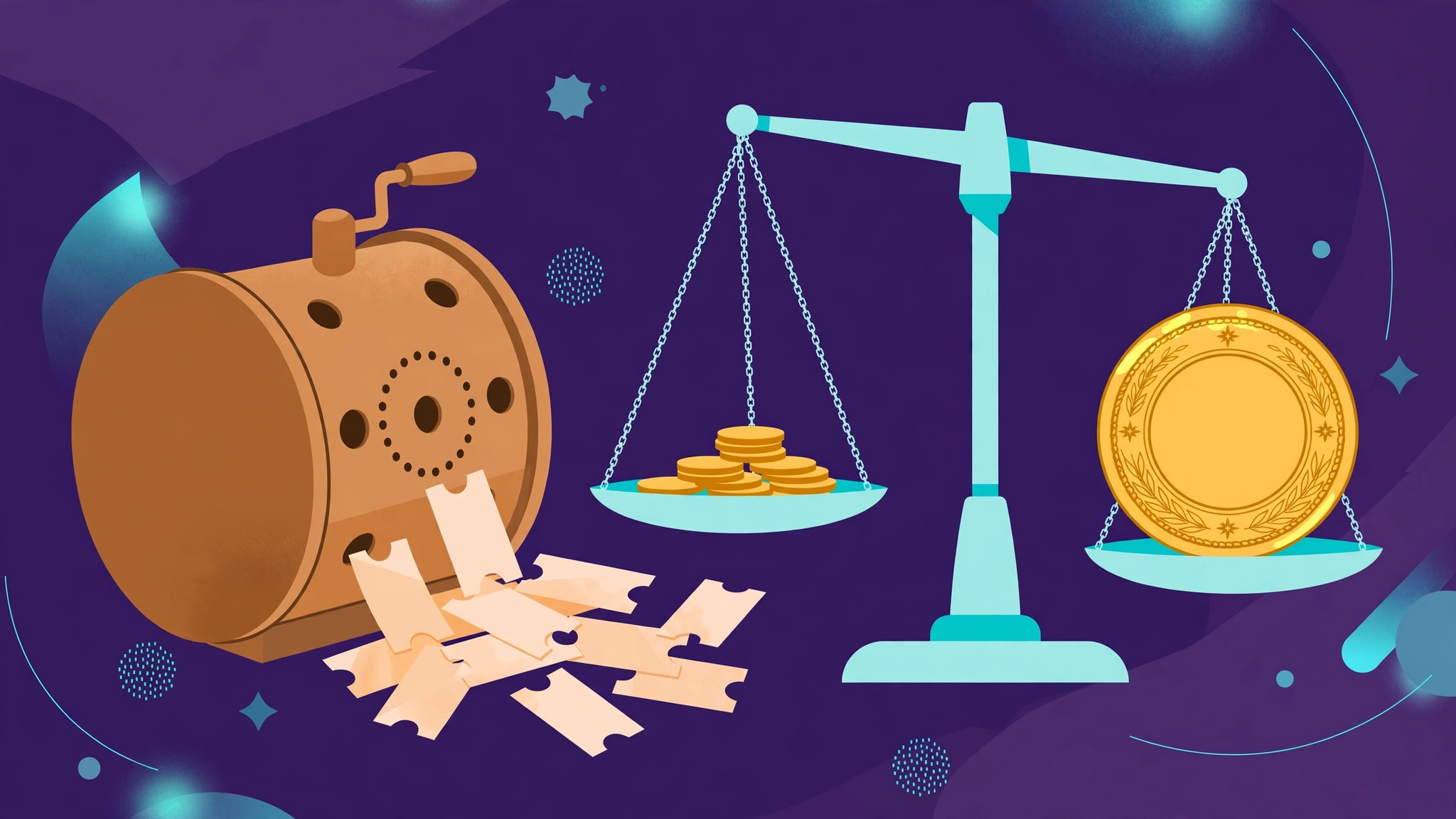
Suppose a raffle sells tickets at 2 each. There is one prize of 500 among 1,000 tickets, and ten prizes of 20. Your expected winnings are 500 times 0.001 plus 20 times 0.01, which is 0.50 plus 0.20, a total of 0.70, against a price of 2. On average you lose 1.30 per ticket, which is exactly how the raffle funds itself. Insurers run the same sums with more zeros: expected claims per policy set the floor for premiums, and the loading above expected value is their margin. Any offer that hides its expected value is hoping you will not do this thirty-second calculation. Lotteries advertise the jackpot and stay silent about the expectation, which for most big games returns only 50 to 60 cents per unit staked.
Variance: the partner number
Two gambles can share an expected value while feeling completely different: one pays small amounts steadily, the other almost always pays nothing but occasionally pays a fortune. The difference is variance, computed from the same table by averaging the squared distance of each outcome from the expected value. High variance means the long run takes longer to arrive, so a player with a small budget can be wiped out before the average asserts itself. Casinos love high-variance games for exactly this reason. Expected value tells you the destination; variance tells you how rough the road is, and serious decisions need both numbers. Investors know the pair as return and risk, and the entire craft of portfolio design is choosing how much variance to accept in exchange for expected return.
Try it with your own numbers
The free calculators that go with this guide:
Calculate an expected value