The Law of Large Numbers: Why Averages Settle Down
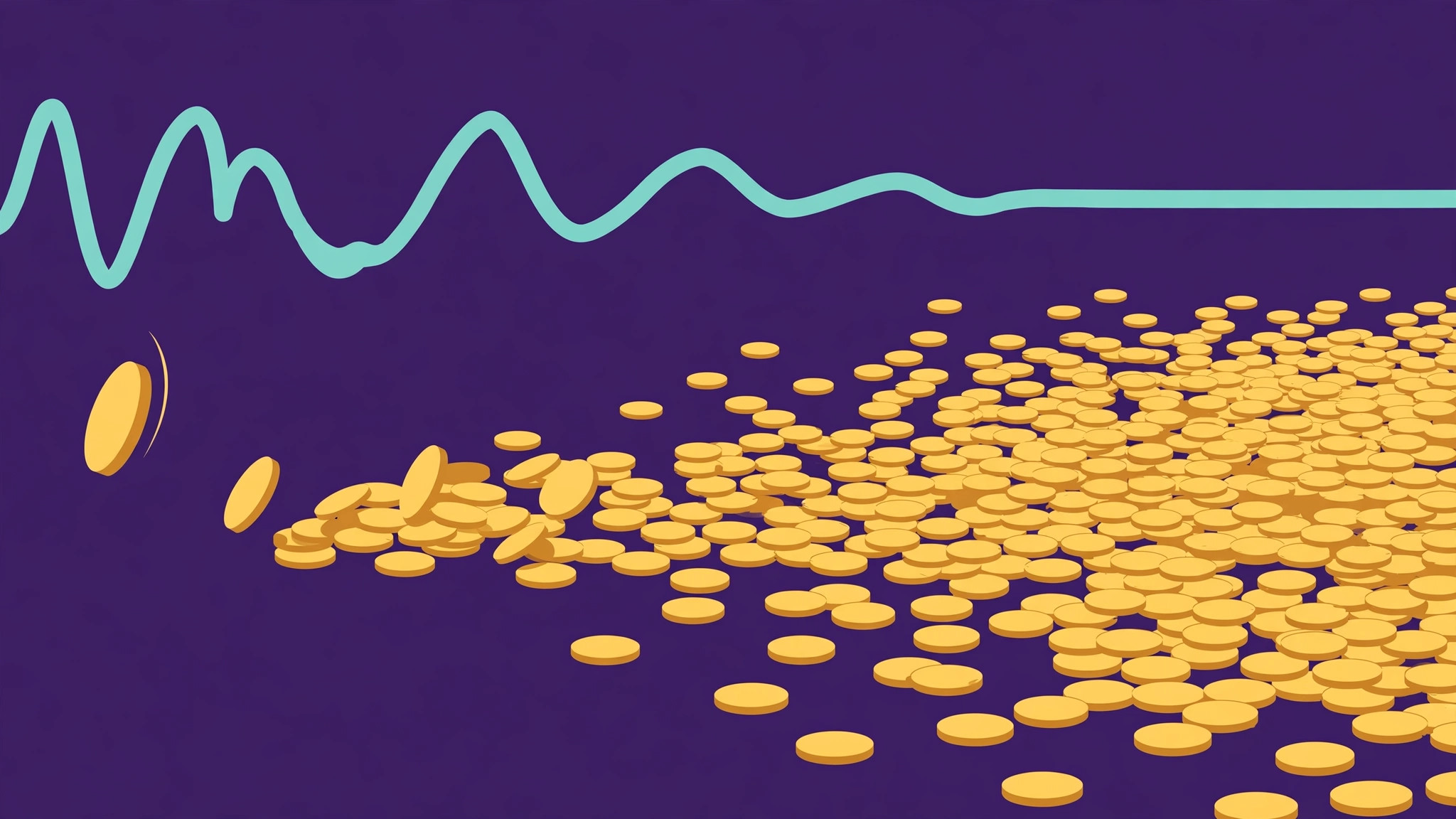
The average behaves in the long run
Flip a fair coin ten times and seven heads is unremarkable. Flip it ten thousand times and seven thousand heads is essentially impossible. The law of large numbers is the theorem behind that intuition: as the number of independent trials grows, the average of the results converges to the expected value. It does not say the coin compensates, evening things out after a streak; the coin has no memory and no conscience. Instead, the early streak is diluted, swamped by the sheer volume of later ordinary outcomes, until its effect on the average is negligible. Convergence is about proportion, not payback, and confusing the two is the gambler's fallacy in a lab coat.
Why institutions love this law
Casinos, insurers and bookmakers do not need to predict any single event; they need the average over millions, and the law hands it to them. Each bet carries a small house edge, an expected value tilted in the house's favour, and the law of large numbers converts that tilt into near-certain profit at scale, while individual punters face the variance. The same mathematics lets a polling firm trust 1,000 interviews and lets a factory trust a sample of parts. The law is also why simulation works: run a computer model a million times and the average outcome is a trustworthy estimate of the true expectation, a technique called Monte Carlo that prices everything from options to epidemics.
The small-sample warning
The law has a dark corollary: small samples are under no obligation to look like the truth. Averages of five observations swing wildly, and early data in any series, a batsman's first innings, a product's first reviews, a fund's first year, is mostly weather, not climate. Judging by small samples is the original statistical sin, and it powers everything from hiring mistakes to miracle cures that fade in larger trials. The practical defence is to ask, of any average, how many observations stand behind it, and to widen your uncertainty as that number shrinks. The law of large numbers promises order eventually; it never promises it soon. Casinos and insurers are the law's industrial applications. Neither knows anything about the next customer; both know a great deal about the next ten thousand. The house edge is a long-run average engineered into every game, and the law guarantees that volume converts it into near-certain profit, which is why casinos limit bets: a single enormous wager reintroduces the short run, where luck still rules. Insurance works identically, pooling many independent risks so the average claim becomes predictable even though each policyholder's fate is not. Wherever you see a business calmly profiting from individually unpredictable events, you are watching this theorem at work, wearing a suit.
Try it with your own numbers
The free calculators that go with this guide:
Calculate an expected value