The Gambler's Fallacy: Why the Coin Owes You Nothing
The coin has no memory
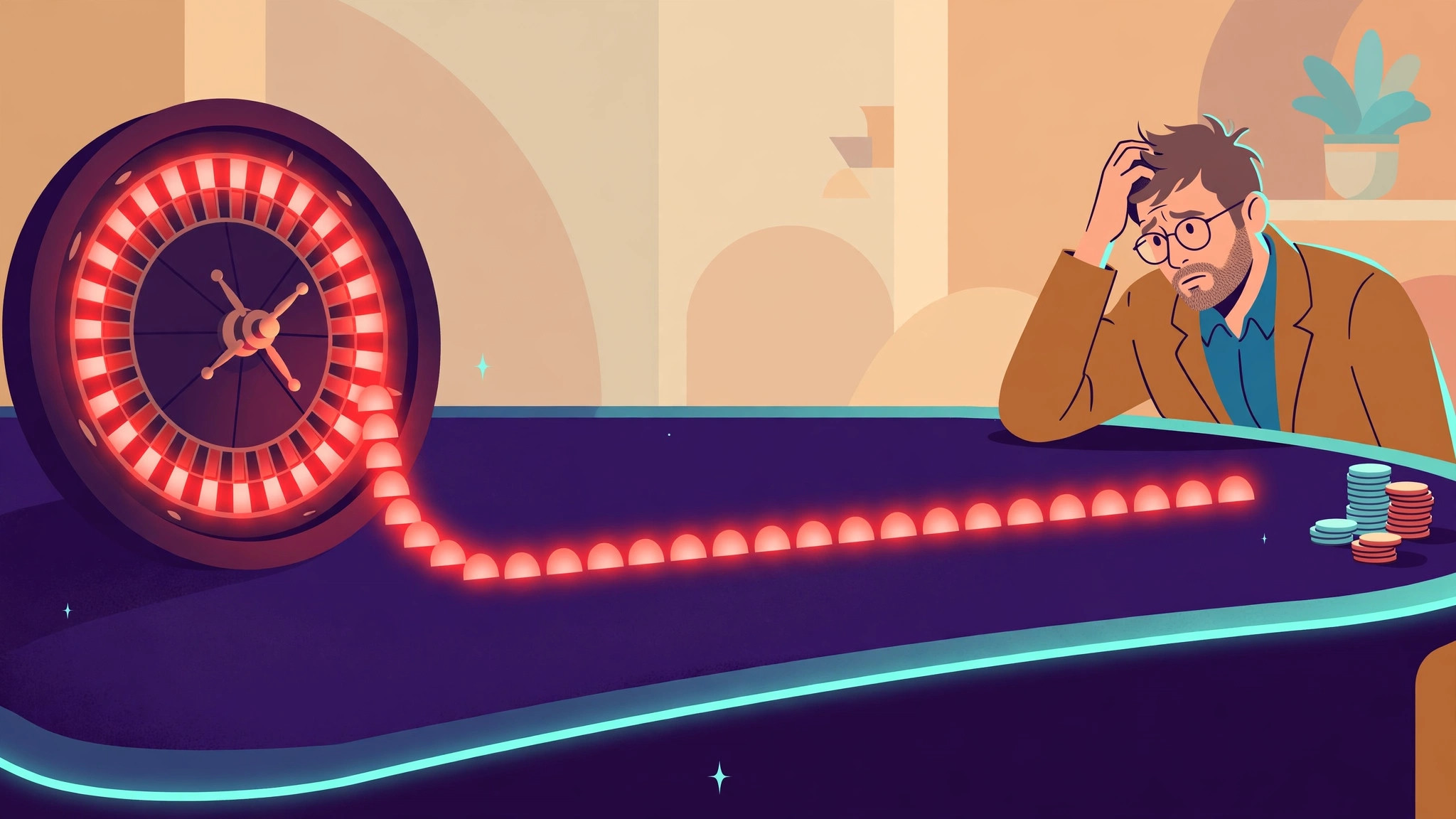
The gambler's fallacy is the belief that past random outcomes influence future ones: after a run of reds, black must be due; after a dry spell, the slot machine is ready. For genuinely independent events it is false in the plainest way: a fair coin that has landed heads five times still lands heads next with probability one half. The famous Monte Carlo evening of 1913, when the roulette ball fell black 26 times in a row, bankrupted a room of fallacy believers who kept betting red as the streak grew. Each spin charged them for the same lesson: probability does not keep accounts, and streaks are what randomness looks like, not evidence against it.
Why the fallacy feels true
The intuition smuggles in the law of large numbers and misreads it. That law promises the proportion of heads settles near one half over time, but it works by dilution, not correction: five early heads are swamped by thousands of later tosses, never cancelled by a compensating run of tails. Our pattern-hungry minds also underestimate how often streaks occur in pure randomness: in 200 coin tosses, a run of six identical outcomes somewhere is not a surprise but an expectation. Clustering is what randomness looks like; perfectly even spacing is the suspicious pattern, which is why fabricated data is often caught for being too smooth, with too few streaks and clumps.
The interesting exception
There is one arena where past performance genuinely informs: when the events are not independent because a hidden quality persists. A basketball player's hot hand was long dismissed as pure fallacy, until careful reanalysis found a small real effect buried under a statistical error in the original study. A fund manager's streak may reflect skill, luck, or risk quietly rising. The fallacy is specifically about independent chance mechanisms, coins, dice, roulette, lotteries, where the apparatus truly forgets. Where a human or a process with memory is involved, the question is empirical, not logical. Knowing which arena you are standing in is the whole skill, and the coin, at least, is honest about forgetting. Its mirror image deserves a footnote: the belief that a winning streak must continue, sometimes called the hot hand fallacy when applied to chance devices. The two errors are twins, both reading meaning into sequences that carry none, differing only in whether the reader expects reversal or continuation. Lottery players exhibit both, avoiding recently drawn numbers as spent and chasing overdue numbers as due, sometimes in the same breath. Randomness is under no obligation to look random to us, and our intuitions about what random looks like, even spacing, no clumps, quick corrections, describe something closer to a shuffled playlist than to chance itself. The coin's indifference is not a puzzle to solve but a fact to budget for.
Try it with your own numbers
The free calculators that go with this guide:
Calculate waiting-time probabilities